

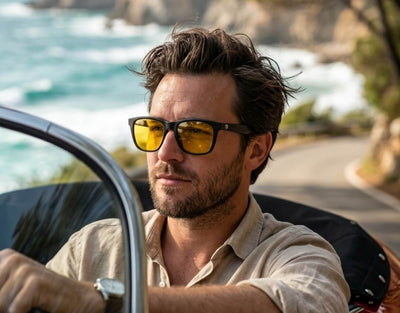
If you've ever tried a pair of yellow-tinted sunglasses, you'll know they offer a very different view of the world. Colours appear warmer, the light takes on a golden tone, and the overall experience can feel quite different from wearing traditional grey or brown lenses.
But what exactly do yellow lenses do? Are they a good choice for daytime driving? And how do you find a comfortable pair if you have a larger-than-average head?
Let's take a closer look.
What makes yellow lenses different?
Most traditional sunglasses use grey, brown or green lenses to reduce brightness while maintaining a relatively natural-looking view.
Yellow lenses work differently. They filter portions of the light spectrum, particularly some shorter-wavelength blue light, giving your surroundings a warmer appearance.
Some people enjoy this effect, especially in overcast or flat-light conditions where the warmer tint can make the view feel more pleasant.
However, it's worth distinguishing personal visual preference from proven improvements in driving performance. Yellow lenses change how things look, but that doesn't automatically mean you'll spot hazards faster or drive more safely.
Why do people choose yellow glasses for driving?
There are several reasons someone might prefer yellow lenses during the day.
A warmer view. Yellow lenses give the surroundings a distinctive golden appearance that some wearers find comfortable and enjoyable.
A different experience in overcast conditions. When the sky is grey and the light feels flat, some people prefer the appearance produced by a yellow tint rather than a darker, neutral-coloured lens.
The option of polarization. Certain yellow lenses also incorporate polarization, which can reduce reflected glare from surfaces such as roads, water and vehicle bodywork.
That last point is particularly important because yellow tint and polarization are two different things.
Yellow lenses vs. polarized lenses: What's the difference?
It's easy to confuse yellow tint with polarization, but they do different jobs.
Yellow tint changes the character of the light reaching your eyes. It gives the view a warmer, more golden appearance that some people prefer, particularly during overcast or flat-light daytime conditions.
Polarization is about reflected glare. It helps reduce glare bouncing from surfaces such as wet roads, water and vehicle bodywork.
The two technologies can be used together, and that's exactly what we do with our yellow driving lenses. Both Faded Days yellow driving lens options featured below are polarized, combining the warmer yellow tint with the glare-reducing benefits of polarization.
That distinction matters when you're shopping. A pair of glasses can have yellow lenses without being polarized, so the colour alone doesn't tell you whether you're also getting glare reduction.
One practical point with any polarized sunglasses is that some electronic displays can look darker or change appearance at certain viewing angles. Before driving in a new pair, simply check your dashboard and other displays while safely parked to make sure everything you need to see remains clear.
Are yellow glasses suitable for night driving?
Yellow lenses are frequently marketed as night-driving glasses, but the evidence supporting that claim is weak.
A 2019 study published in JAMA Ophthalmology found no significant improvement in nighttime pedestrian detection when participants wore the yellow-lens glasses tested.
Any tinted lens also reduces at least some of the light reaching your eyes. That's an important consideration when visibility is already limited.
For that reason, we wouldn't recommend choosing yellow glasses on the assumption that they'll improve your night vision.
Our focus here is daytime eyewear.
Finding yellow glasses that actually fit a larger head
Here's something that often gets overlooked in discussions about driving glasses: comfort.
You can spend hours researching lens colours and coatings, but none of that matters much if your sunglasses squeeze your temples, slide down your nose or become uncomfortable halfway through a journey.
For people with larger heads, finding properly proportioned sunglasses can be particularly frustrating.
At Faded Days, we specialize in eyewear designed for wider faces, including frames measuring 155mm XL and 165mm XXL.
If you're interested in yellow lenses, we currently offer two different 165mm frame styles worth comparing.
Two yellow-lens options from Faded Days
The XXL: Classic styling with a generous fit

Our 165mm XXL sunglasses offer a traditional frame shape designed for people who struggle with standard-width sunglasses.
With a 165mm front width and longer temples, they're an option for anyone who prefers classic styling but needs more room around the sides of their head.
The range includes a yellow-lens option listed as XXL Driving Glasses.
If you prefer a traditional everyday frame rather than a sporty wraparound design, this is a good place to start.
The Sport: A wraparound alternative

Our 165mm Sport sunglasses take a different approach.
They feature a wraparound design with spring hinges and the same stated 165mm overall width.
The Sport range includes a Yellow Polarized Driving Lenses option with a non-mirrored finish.
The wraparound shape gives the frame a sportier appearance, while the spring hinges provide some flexibility.
Although both frames measure 165mm across the front, they won't necessarily feel identical. Frame curvature, bridge shape and temple positioning all influence comfort.
Three things to check before buying
When comparing yellow-lens glasses for daytime use, keep these three considerations in mind.
1. Lens characteristics. Check the actual lens option, including whether it is polarized and how much visible light it transmits. Lens colour alone doesn't establish suitability for every driving condition.
2. Frame width. If standard sunglasses consistently pinch your temples, look for an actual width measurement rather than relying on labels such as Large or XL.
3. Comfort and visibility. Your glasses should sit securely without excessive pressure. While safely parked, check that your dashboard and electronic displays remain easy to read through the lenses..
If you're unsure which width to choose, our Faded Days fitting guide can help you narrow down the options.
So, are yellow driving glasses worth trying?
That depends on what you're looking for.
If you enjoy a warmer view, prefer the appearance of yellow lenses in certain daytime conditions or want a different alternative to traditional grey and brown sunglasses, they may be worth considering.
If your main objective is reducing reflected glare, look for a polarized option rather than assuming the yellow tint itself provides that benefit.
And if you've spent years struggling to find sunglasses wide enough to fit comfortably, choosing the right frame may make the biggest difference to your everyday experience.
At Faded Days, that's what we specialize in: helping people with larger heads find sunglasses that actually fit.
Explore our 165mm XXL and 165mm Sport yellow-lens options and discover which frame style suits you best.